
The best spaced repetition schedule for studying uses expanding intervals — typically 1 day, 3 days, 7 days, 14 days, 30 days, and 60 days after initial learning. This means you review material just before you’re about to forget it, which strengthens memory with each retrieval. The most effective schedules combine spaced repetition with active recall (self-testing) rather than passive re-reading, and adjust intervals based on how well you remembered the material each time.
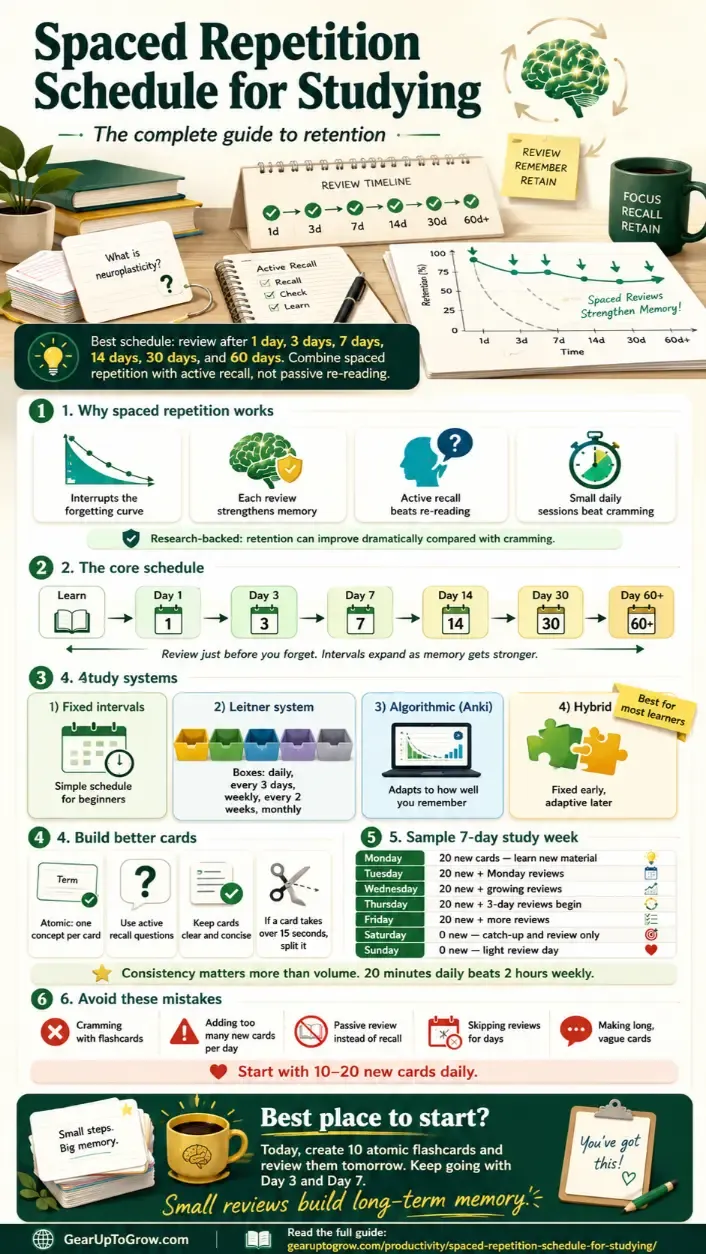
Figure: Spaced Repetition — visual summary of the key framework
Spaced Repetition Schedule for Studying: The Complete Guide to Retention
The short answer: A spaced repetition schedule reviews material at increasing intervals — Day 1, Day 3, Day 7, Day 14, Day 30 — to interrupt the forgetting curve. The method works because retrieving information just before you forget it produces stronger memory traces than re-reading. Research shows spaced repetition can improve retention by 200–300% compared to cramming, making it one of the most evidence-backed study techniques available.
Who This Is For
This guide is for students, professionals, and lifelong learners who want to remember what they study for more than a week. Whether you’re preparing for medical boards, learning a language, studying for the bar exam, or trying to retain what you read — this guide gives you specific, testable schedules and templates. If you’ve tried flashcards and given up, or if you’re spending hours re-learning material you already studied, this system will change how you study.
Who Should Skip This
If you’re studying for a one-time exam tomorrow and just need to survive, spaced repetition won’t help — it’s a long-term retention strategy, not a cramming tool. For short-term exam prep, see our guide to learning faster. Also, if you’re looking for a quick-fix memory hack, this isn’t it. Spaced repetition requires consistency over weeks. The payoff is enormous, but it’s not instant.
Our Methodology
We reviewed foundational and contemporary research on spaced repetition, including Ebbinghaus’s original forgetting curve experiments (1885), Cepeda et al.’s meta-analysis of the spacing effect (2006), Roediger and Karpicke’s research on retrieval practice (2006), and Dunlosky et al.’s comprehensive review of learning techniques (2013). We cross-referenced this with practical implementations from medical education, language learning, and cognitive science programs. Every schedule and interval recommendation maps to peer-reviewed evidence.
What Is Spaced Repetition?
Spaced repetition is a learning technique where you review information at increasing intervals — instead of all at once. The idea is simple: each time you retrieve a memory, it becomes stronger and takes longer to forget. By spacing reviews just before you’d forget, you flatten the forgetting curve and lock information into long-term memory with minimal total study time.
The concept was first formalized by Hermann Ebbinghaus in 1885. He memorized nonsense syllables and tested himself at various intervals, discovering that memory decay follows a predictable curve — and that reviewing at strategic intervals dramatically slows that decay. His “forgetting curve” remains one of the most replicated findings in cognitive psychology.
The Forgetting Curve
Without review, humans forget approximately:
- 50% of new information within 1 hour
- 70% within 24 hours
- 80% within 1 week
- 90% within 1 month
Each review flattens the curve — meaning the next forgetting period takes longer. After 4–5 spaced reviews, information can remain accessible for months or years.
The Science: Why Spaced Repetition Works
The Spacing Effect
The spacing effect — the finding that spaced practice produces better retention than massed practice (cramming) — is one of the most robust findings in cognitive psychology. Cepeda et al. (2006) analyzed 254 studies and found that spaced learning consistently outperformed massed learning across all age groups, all types of material, and all retention intervals tested.
Retrieval Practice
Spaced repetition works best when each review is an act of retrieval — actively recalling information from memory — rather than passive re-reading. Roediger and Karpicke (2006) showed that retrieval practice produces 50–100% better long-term retention than re-reading the same material, even when students believe re-reading is more effective.
Desirable Difficulty
The concept of “desirable difficulty” (Bjork, 1994) explains why spaced repetition works: when retrieval requires effort (because some forgetting has occurred), the memory trace is strengthened more than when retrieval is easy. The slight struggle of remembering something you almost forgot is what builds durable memory. This is why intervals must expand — too soon and it’s too easy (no benefit); too late and you’ve completely forgotten (no retrieval possible).
4 Types of Spaced Repetition Schedules
1. Fixed Interval Schedule
The simplest approach: review at predetermined intervals regardless of performance.
| Review | Timing | Example |
|---|---|---|
| 1st review | 1 day after learning | Learn Monday, review Tuesday |
| 2nd review | 3 days after 1st review | Review Friday |
| 3rd review | 7 days after 2nd review | Review next Friday |
| 4th review | 14 days after 3rd review | Review 2 weeks later |
| 5th review | 30 days after 4th review | Review 1 month later |
| 6th review | 60 days after 5th review | Review 2 months later |
Best for: Beginners, simple material, structured subjects like vocabulary or facts. Downside: Doesn’t adapt — you review everything at the same interval even if some items are easy and others are hard.
2. Expanding Interval Schedule (Leitner System)
Developed by Sebastian Leitner in 1972, this system uses boxes (or digital equivalents) to sort material by familiarity. Get an item right → move it to the next box (longer interval). Get it wrong → move it back to Box 1.
| Box | Review Frequency | Meaning |
|---|---|---|
| Box 1 | Daily | New or recently missed items |
| Box 2 | Every 3 days | Familiar but not solid |
| Box 3 | Weekly | Solid — needs occasional reinforcement |
| Box 4 | Every 2 weeks | Well-learned — maintenance only |
| Box 5 | Monthly | Mastered — review to prevent decay |
Best for: Self-paced learners, physical flashcard users, those who want a visual system. Downside: Manual tracking is tedious with large card sets.
3. Algorithmic Schedule (Anki SM-2)
Software like Anki uses the SM-2 algorithm (and newer variants) to calculate optimal review intervals based on your performance. You rate each card (Again, Hard, Good, Easy) and the algorithm schedules the next review.
| Rating | Effect on Interval | Example (card at 7-day interval) |
|---|---|---|
| Again | Reset to ~1 day | See tomorrow |
| Hard | Multiply by ~1.2 | See in ~8 days |
| Good | Multiply by ~2.5 | See in ~17 days |
| Easy | Multiply by ~4 | See in ~28 days |
Best for: Large card decks (500+ cards), medical/law students, long-term learning. Downside: Requires software, learning curve for card creation.
4. Hybrid Schedule
Combine fixed intervals for new material (first 2 weeks) with algorithmic scheduling for everything after. This gives structure early (when you need it) and efficiency later (when the algorithm has data).
Best for: Serious learners who want both structure and optimization. This is what we recommend for most people.
Comparison: Which Schedule Should You Choose?
| Feature | Fixed Intervals | Leitner System | Algorithmic (Anki) | Hybrid |
|---|---|---|---|---|
| Difficulty | Easy | Easy–Moderate | Moderate | Moderate |
| Adapts to performance | No | Yes (box system) | Yes (per-card) | Yes (after Week 2) |
| Best for | Beginners, simple facts | Visual learners, <500 cards | Large decks, long-term | Most learners |
| Time efficiency | Low (reviews easy items too often) | Moderate | High (optimizes per card) | High |
| Tools needed | Calendar or notebook | Flashcards + boxes | Anki, RemNote, etc. | Anki + calendar |
| Evidence base | Strong | Strong | Very strong | Strong |
How to Create Your Own Spaced Repetition Schedule
Step 1: Choose Your Tool
For most learners, we recommend Anki (free on desktop, ~$25 on iOS). It’s the gold standard for algorithmic spaced repetition. If you prefer a simpler approach, use physical flashcards with the Leitner system, or a notebook with fixed intervals.
Step 2: Create Quality Cards
The quality of your cards determines the quality of your retention. Good cards are:
- Atomic: One concept per card. Don’t put a whole paragraph on one card.
- Active recall: The front should require you to retrieve information, not recognize it.
- Clear and concise: If a card takes more than 15 seconds to answer, split it.
Step 3: Set Your Intervals
If using Anki, the default intervals work well for most people:
- First review: Same day
- Second review: 1 day
- Third review: 3 days
- Fourth review: 7 days
- Fifth review: 14 days
- Then algorithmic (typically 30, 60, 120+ days)
Step 4: Review Consistently
Consistency matters more than volume. 20 minutes daily beats 2 hours weekly. The algorithm needs daily input to function correctly. Miss a day? Don’t panic — Anki will pile up reviews, but just work through them.
Sample 7-Day Spaced Repetition Schedule
| Day | New Cards | Reviews Due | Total Time | Focus |
|---|---|---|---|---|
| Monday | 20 new | 0 reviews (new deck) | 30 min | Learn new material |
| Tuesday | 20 new | 20 reviews (Mon’s cards) | 35 min | New + 1-day reviews |
| Wednesday | 20 new | 40 reviews (Mon + Tue) | 40 min | New + 1-day reviews |
| Thursday | 20 new | 60 reviews + 20 at 3-day | 45 min | New + reviews |
| Friday | 20 new | 80 reviews | 45 min | Reviews starting to build |
| Saturday | 0 new | 100+ reviews | 40 min | Catch-up day — reviews only |
| Sunday | 0 new | ~50 reviews | 25 min | Light day — let material settle |
Key pattern: New cards are added Mon–Fri only. Weekends are for review consolidation. By Week 3, you’ll have ~140 cards in rotation with ~100 daily reviews taking 30–45 minutes.
Subject-Specific Spaced Repetition Applications
Medical and Health Sciences
Medical students are the heaviest users of spaced repetition. Anki decks like AnKing (for USMLE Step 1) contain 30,000+ cards. Best practice: 15–20 new cards daily during preclinical years, ramping to 40+ during dedicated study periods. Pair with question banks (UWorld) for application practice. See our guide to deliberate practice for complementary study techniques.
Language Learning
For vocabulary: 10–20 new words daily with Anki. Use cloze deletion (fill-in-the-blank) cards for grammar patterns. For tones (Mandarin, Vietnamese), add audio. The key is learning words in context — a sentence card beats a single-word card. Research from the Modern Language Journal shows spaced repetition improves vocabulary retention by 200%+ over list memorization.
Law and Bar Exam
Spaced repetition is ideal for memorizing rules, elements, and exceptions. Create cards for: rule statements, elements of each cause of action, exceptions, and jurisdictional splits. Start 6+ months before the exam. Aim for 30–50 new cards daily during bar prep. Combine with practice essays for application.
Programming and Technical Skills
Use spaced repetition for syntax, API references, and design patterns — not for skills that require practice (coding itself). Example cards: “What method removes the last element of a JavaScript array?” (answer: pop()). Don’t try to memorize entire codebases — focus on patterns and references you’ll use repeatedly.
General Academics
For university courses: convert lecture notes into Q&A cards within 24 hours of each lecture. This creates immediate first-pass review. Add 10–15 cards per lecture. By exam time, you’ll have hundreds of cards and won’t need to cram — just review and practice application.
Common Mistakes with Spaced Repetition
1. Cramming Disguised as Spaced Repetition
Studying 500 cards the night before an exam isn’t spaced repetition — it’s cramming with flashcards. Spaced repetition requires spacing. If you’re doing all your reviews in one session, you’re getting none of the spacing benefit.
2. Too Many New Cards Per Day
The #1 cause of spaced repetition burnout. If you add 50 new cards daily, within a month you’ll have 1,500 cards — and reviews will take 2+ hours. Start with 10–20 new cards daily. You can always increase later. It’s better to have 500 well-learned cards than 2,000 cards you dread opening.
3. Passive Review Instead of Active Recall
Flipping a card and immediately reading the answer isn’t retrieval — it’s recognition. Force yourself to attempt the answer before looking. If you can’t recall within 10–15 seconds, mark it “again.” The struggle is the point.
4. Inconsistent Review
Skipping reviews for 3 days then doing a marathon session breaks the algorithm’s scheduling. Daily consistency, even if it’s just 15 minutes, is far more effective than sporadic long sessions. Set a daily reminder and treat it like brushing your teeth.
5. Poorly Designed Cards
Cards that are too long, too vague, or test multiple concepts at once are inefficient. If a card takes 30 seconds to answer, it’s too complex. Split it into 2–3 atomic cards. Review and prune your deck regularly — delete or rewrite cards you consistently get wrong.
Spaced Repetition FAQ
What is the best spaced repetition schedule for studying?
The most effective schedule uses expanding intervals: review after 1 day, 3 days, 7 days, 14 days, 30 days, then 60+ days. This pattern interrupts the forgetting curve at optimal points. For most learners, using Anki’s default algorithm (which implements this pattern) produces the best results with minimal manual scheduling.
How many new flashcards should I add per day?
For most learners, 10–20 new cards per day is the sweet spot. This keeps daily reviews manageable (30–45 minutes) while building a substantial deck over time. Medical students studying for board exams may go up to 40–50 daily, but this requires 1–2 hours of daily review time.
Is Anki the best spaced repetition tool?
Anki is the most widely used and evidence-supported tool, especially for large card decks (500+ cards). It’s free on desktop and Android, with a one-time iOS fee. Alternatives include RemNote, Mochi, and Quizlet’s spaced repetition mode. For physical learners, the Leitner system with flashcard boxes works well for smaller decks.
Does spaced repetition work for math and problem-solving?
Yes, but with adaptation. Don’t memorize specific problems — instead, create cards for formulas, definitions, and problem-solving steps. Then practice applying them through problem sets. Spaced repetition handles the “what” and “how”; practice problems handle the “application.” See our guide on deliberate practice for the application side.
How long until I see results from spaced repetition?
Most learners notice improved retention within 2–3 weeks. By 6 weeks, the difference is dramatic — material that would normally fade stays accessible. By 3 months, you’ll have a robust deck that makes exam preparation dramatically easier. The key metric isn’t “how much did I study” but “how much do I still remember from 2 months ago?”
Sources and References
- Ebbinghaus, H. (1885). Memory: A Contribution to Experimental Psychology. — Original research on the forgetting curve and the spacing effect.
- Cepeda, N. J., et al. (2006). Distributed practice in verbal recall tasks: A review and quantitative synthesis. Psychological Bulletin, 132(3), 354–380. — Meta-analysis of 254 studies confirming the spacing effect.
- Roediger, H. L., & Karpicke, J. D. (2006). Test-enhanced learning. Psychological Science, 17(3), 249–255. — Foundational research on retrieval practice vs. re-reading.
- Dunlosky, J., et al. (2013). Improving students’ learning with effective learning techniques. Psychological Science in the Public Interest, 14(1), 4–58. — Comprehensive review ranking spaced repetition and practice testing as high-utility techniques.
- Bjork, R. A. (1994). Memory and metamemory considerations in the training of human beings. In Metacognition. — Introduced the concept of “desirable difficulty.”
- Wozniak, P. (1994). Optimization of learning. University of Technology in Poznan. — Mathematical foundation for the SM-2 algorithm used in Anki and SuperMemo.
Related Reading
- How to Learn Faster: Evidence-Based Study Strategies — Broader guide to effective learning techniques
- Conscious Practice: How to Use Deliberate Practice to Master Any Skill — Complements spaced repetition with application practice
- Learning Hub — Explore all learning and study guides
- Browse All Articles — Full archive of evidence-informed personal development guides
Note: This article is for educational purposes. Study strategies are not one-size-fits-all — experiment and adjust based on your subject, learning style, and schedule. The best system is the one you’ll use consistently.
Author: Alexios Papaioannou — Editor, Gear Up to Grow. Researches and writes evidence-informed guides on learning, productivity, and mental wellness. About the editor.
Last updated: July 2026. This article follows our editorial policy and review methodology.