
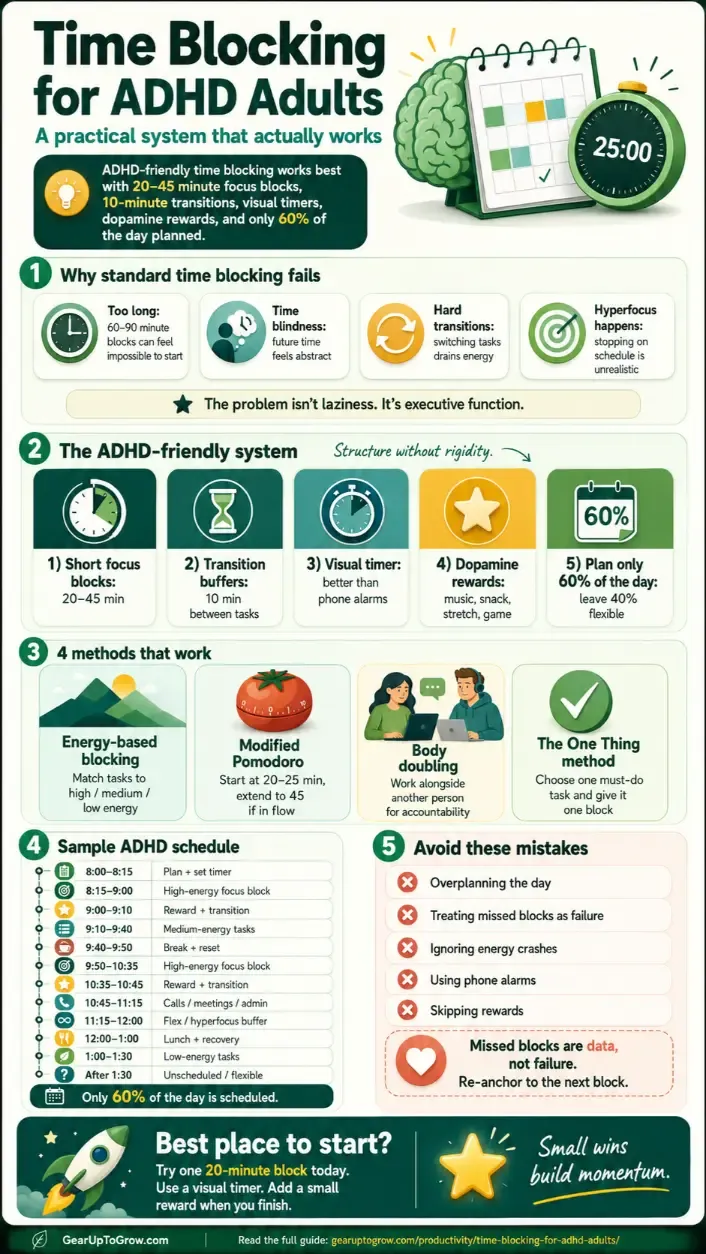
Figure: Time Blocking for ADHD — visual summary of the key framework
Time Blocking for ADHD Adults: A Practical System That Actually Works
The short answer: Yes, time blocking works for ADHD adults — but only when modified. Replace 90-minute blocks with 25–45 minute focus sessions, add 10-minute transition buffers between tasks, use visual timers instead of phone alarms, build in dopamine rewards after each block, and plan only 60% of your day so hyperfocus and energy crashes have room. The goal is structure without rigidity.
Who This Is For
This guide is for adults with ADHD (diagnosed or self-identified) who have tried standard productivity systems and felt worse for failing. You already know what to do — the problem is doing it consistently. If task initiation feels like hitting a wall, if “just start” sounds like a cruel joke, and if hyperfocus makes you forget to eat, this system is built for you.
Who Should Skip This
If you don’t struggle with executive function, this guide will feel overengineered. Standard time blocking works fine for neurotypical brains. Also, if you’re in active burnout or crisis, productivity systems aren’t the priority — see our burnout symptoms guide first and consider professional support.
Our Methodology
We reviewed research on ADHD and executive function from the National Institutes of Health, the American Psychological Association, and peer-reviewed cognitive science literature. We cross-referenced ADHD-specific productivity adaptations from ADDitude Magazine and tested them against the lived experience of ADHD adults. Every recommendation here maps to a specific executive function challenge — not a neurotypical productivity tip retrofitted with “just try harder.”
Why Standard Time Blocking Fails for ADHD Brains
Standard time blocking asks you to: estimate how long tasks take, initiate tasks on command, switch between tasks smoothly, and resist distractions for 60–90 minutes. These are all executive function skills — the exact cognitive abilities that ADHD impairs.
The Executive Function Wall
Executive function is your brain’s management system. It handles task initiation, working memory, planning, and cognitive flexibility. Research published in the Journal of Attention Disorders shows that adults with ADHD score significantly lower on executive function tests across all domains. When a standard time blocking guide says “block 9–10:30 AM for deep work,” it assumes you can:
- Start working at 9:00 exactly (task initiation)
- Remember what you planned to do (working memory)
- Estimate that the task takes 90 minutes (time estimation)
- Switch to the next task at 10:30 without a 20-minute scrolling break (cognitive flexibility)
Why Standard Time Blocking Fails for ADHD Brains
Standard time blocking assumes a neurotypical prefrontal cortex. It assumes you can:
- Accurately estimate how long tasks take
- Switch between tasks on schedule
- Start a task when the calendar says to
- Stop a task when the block ends
- Remember what block you’re in without checking
ADHD brains struggle with all five. Here’s why:
Executive Dysfunction
ADHD is fundamentally a disorder of executive function — the brain’s management system. Research published in the Journal of Attention Disorders shows that adults with ADHD score significantly lower on task initiation, working memory, and planning compared to neurotypical adults. Standard time blocking requires all three simultaneously.
Time Blindness
People with ADHD experience time differently. A phenomenon called “time blindness” means the future feels abstract and distant, even when it’s five minutes away. A 2021 study in Neuroscience & Biobehavioral Reviews found that ADHD adults underestimate time intervals by 20–40%, making scheduled blocks feel arbitrary and unreal.
Dopamine and Motivation Gaps
ADHD brains have atypical dopamine regulation. Dopamine drives motivation and reward anticipation — the feeling that a task is “worth starting.” When dopamine is low, the brain can’t bridge the gap between “I should do this” and “I’m doing this.” No calendar notification can override this gap. You need systems that generate dopamine, not just schedule tasks.
Hyperfocus: The Double-Edged Sword
ADHD brains can enter states of intense, sustained focus — but unpredictably. When hyperfocus engages, it’s nearly impossible to disengage on schedule. Standard time blocking treats this as a failure (“you went over your block”). ADHD-adapted time blocking treats it as a feature and builds flexibility for it.
4 ADHD-Adapted Time Blocking Methods
Method 1: Energy-Based Time Blocking
Instead of blocking by the clock, block by energy level. Track your energy for one week (high, medium, low, crash) and assign task types to each energy state.
| Energy State | Best For | Block Length | Example Tasks |
|---|---|---|---|
| High (morning peak) | Deep, novel, creative work | 45 min | Writing, strategy, complex problem-solving |
| Medium (afternoon) | Familiar, structured tasks | 30 min | Email, meetings, admin, editing |
| Low (late afternoon) | Low-stakes, physical, or routine tasks | 20 min | Filing, organizing, errands |
| Crash (post-lunch dip) | Rest or passive learning | 30 min | Walk, nap, podcast, light reading |
Why it works for ADHD: You’re not fighting your dopamine curve — you’re riding it. High-energy blocks capitalize on natural focus windows. Low-energy blocks prevent the guilt spiral of “I should be working but can’t.”
Method 2: Modified Pomodoro for ADHD
The standard Pomodoro Technique (25 minutes work, 5 minutes break) can work for ADHD, but needs modifications:
- Shorten to 20 minutes if 25 feels too long for task initiation
- Extend to 45 minutes if you enter hyperfocus — don’t break a productive streak
- Use a visual timer (like a Time Timer) that shows time disappearing — this combats time blindness
- Add a dopamine reward after each completed block: a favorite song, a piece of chocolate, 2 minutes of a game
- Build in 10-minute transitions between blocks — ADHD brains need runway to shift gears
Compare this with our analysis of Pomodoro vs. deep work for more on how these methods differ.
Method 3: Body Doubling Blocks
Body doubling — working alongside someone else — is one of the most effective ADHD focus strategies. It provides external structure and accountability without micromanagement.
- Schedule a 60-minute body doubling block with a coworker, friend, or virtual service
- State your task at the start: “I’m going to draft the project proposal for 45 minutes”
- Work silently in parallel
- Check in at the end: “I got through the outline and first section”
The social presence provides dopamine through mild accountability, making task initiation easier. Research on “social facilitation” shows that the mere presence of another person improves performance on tasks — particularly for people with attention difficulties.
Method 4: The “One Thing” Method
When executive dysfunction is severe, even a half-day schedule is too much. The One Thing method reduces planning to a single anchor:
- Choose ONE task for the day (not a list — one)
- Assign it ONE time block (45 minutes)
- Everything else is optional
This removes decision fatigue and working memory load. If you complete the one thing, the day is a success. If hyperfocus carries you into other tasks, great. If you only do the one thing, you still won.
Sample ADHD Time Blocking Schedule
| Time | Block | Purpose |
|---|---|---|
| 8:00–8:15 AM | Transition + visual planning | Review today’s ONE thing; set visual timer |
| 8:15–9:00 AM | High-energy focus block (45 min) | Most important/novel task |
| 9:00–9:10 AM | Dopamine reward + transition | Music, stretch, snack |
| 9:10–9:40 AM | Medium-energy block (30 min) | Familiar tasks, email, admin |
| 9:40–9:50 AM | Break + transition | Walk, water, reset visual timer |
| 9:50–10:35 AM | High-energy focus block (45 min) | Second priority task |
| 10:35–10:45 AM | Dopamine reward + transition | Reward, check in with body double |
| 10:45–11:15 AM | Medium-energy block (30 min) | Calls, meetings, collaboration |
| 11:15 AM–12:00 PM | Flex / hyperfocus buffer | If in flow, keep going. If not, low-stakes tasks |
| 12:00–1:00 PM | Lunch + crash recovery | Eat, walk, rest — no guilt |
| 1:00–1:30 PM | Low-energy block (30 min) | Organize, file, plan tomorrow |
| After 1:30 PM | Unscheduled | Only 60% of the day is planned — the rest is recovery and flexibility |
Key differences from standard time blocking: Only 60% of the day is scheduled. Transition time is built in, not improvised. Dopamine rewards are explicit. The afternoon is intentionally light.
Comparison: ADHD-Adapted vs. Standard Time Blocking
| Feature | Standard Time Blocking | ADHD-Adapted Time Blocking |
|---|---|---|
| Block length | 60–120 minutes | 20–45 minutes |
| Transition time | 0 minutes (back-to-back) | 10 minutes between blocks |
| Day utilization | 90–100% scheduled | 60% scheduled, 40% flex |
| Timer type | Phone alarm | Visual timer (Time Timer) |
| Task initiation | “Just start at 9 AM” | Body doubling + dopamine priming |
| Hyperfocus | Treated as schedule violation | Treated as feature; blocks extend |
| Missed blocks | Failure → guilt spiral | Expected; re-anchor to next block |
| Reward system | End-of-day completion | Micro-rewards after each block |
Common Mistakes When Time Blocking with ADHD
1. Overplanning the Day
ADHD brains love planning — it provides a dopamine hit without requiring action. You can spend 45 minutes color-coding a perfect schedule and feel productive without doing anything. Limit planning to 10 minutes. Use our free time blocking template to skip the planning phase entirely.
2. Treating Missed Blocks as Failure
In standard productivity culture, missing a block means you failed. For ADHD brains, this triggers rejection sensitivity and shame — which shuts down executive function further. Instead: missing a block is data, not failure. Re-anchor to the next block. The schedule is a suggestion, not a verdict.
3. Ignoring Energy Crashes
ADHD medication effects, circadian rhythm dips, and dopamine depletion all cause energy crashes. If you schedule through them, you’ll fail every time. Build crash time into your schedule. See our guide on sleep and productivity for more on managing energy.
4. Using Phone Alarms
Phone alarms are the worst timer for ADHD. They interrupt without context, require dismissal (a task), and lead to phone checking (a rabbit hole). Use a visual timer that shows time elapsing. This provides continuous time awareness without requiring working memory.
5. No Reward System
ADHD brains need dopamine to initiate and sustain effort. If there’s no reward, the brain won’t engage. Build micro-rewards into every block: a favorite song, a stretch, a sip of good coffee, two minutes of a game. These aren’t distractions — they’re the fuel that makes the system work.
ADHD Time Blocking FAQ
Does time blocking work for ADHD?
Yes — when adapted. Standard time blocking fails because it demands executive function skills that ADHD impairs. Modified time blocking with shorter blocks, visual timers, transition buffers, and dopamine rewards works well. The key is structure without rigidity.
What is the best time blocking method for ADHD adults?
Energy-based time blocking is the most effective starting point. It aligns tasks with your natural dopamine and energy cycles instead of fighting them. If energy-based feels too complex, start with the One Thing method: one task, one block, everything else optional.
How long should time blocks be for ADHD?
20–45 minutes for focus blocks, with 10-minute transitions between them. Start with 25 minutes and adjust. If task initiation is the main struggle, start with 20-minute blocks. If hyperfocus is your pattern, allow blocks to extend to 45–60 minutes when you’re in flow.
Can I use the Pomodoro Technique with ADHD?
Yes, with modifications. Shorten sessions to 20 minutes if 25 feels too long. Use a visual timer instead of a phone alarm. Add a dopamine reward after each session. Allow hyperfocus sessions to extend beyond 25 minutes when you’re productively engaged. See our comparison of Pomodoro vs. deep work for more context.
What if I keep missing my time blocks?
Missing blocks is normal for ADHD brains — it’s data, not failure. Reduce your scheduled time to 50% of the day. Shorten blocks to 20 minutes. Add body doubling for external structure. And stop planning the whole day — plan only the first 3 hours. More on this in our guide to ending procrastination.
Sources and References
- Brown, T. E. (2013). A New Understanding of ADHD in Children and Adults: Executive Function Impairments. American Psychiatric Publishing. — Foundational research on ADHD as an executive function disorder.
- Volkow, N. D., et al. (2009). Evaluating dopamine reward pathway in ADHD. Journal of the American Medical Association, 302(10), 1084–1091. — NIH research on dopamine and ADHD motivation.
- Faraone, S. V., et al. (2021). The worldwide prevalence of ADHD. Neuroscience & Biobehavioral Reviews. — Meta-analysis on ADHD prevalence and time perception differences.
- American Psychiatric Association. (2022). Diagnostic and Statistical Manual of Mental Disorders (5th ed., text rev.). — ADHD diagnostic criteria including executive function impairments.
- ADDitude Magazine. Time Management Strategies for Adults with ADHD. Retrieved from additudemag.com. — Practical ADHD time management research summaries.
Related Reading
- Complete Time Blocking Guide — The foundational guide (start here if you’re new to time blocking)
- Free Time Blocking Template — Download and adapt for your energy patterns
- Time Blocking vs. Time Boxing vs. Task Batching — Which method fits your brain?
- Deep Work Schedule Examples — How to structure deep focus sessions
- How to Improve Focus — Broader focus strategies that complement time blocking
- Productivity Hub — Explore all productivity guides
Disclaimer: This article is educational, not medical advice. If you have ADHD, work with a qualified healthcare provider for diagnosis and treatment. Productivity systems complement but do not replace professional care.
Author: Alexios Papaioannou — Editor, Gear Up to Grow. Researches and writes evidence-informed guides on productivity, focus, and mental wellness. About the editor.
Last updated: July 2026. This article follows our editorial policy and review methodology.