
You can recover from burnout while working — but it requires a systematic approach, not willpower. Recovery means reducing cognitive load, managing energy instead of just time, setting boundaries that stick, and rebuilding a sustainable relationship with work. Most people need 6–12 weeks of consistent changes to feel significantly better. This guide walks you through a practical 4-week framework you can start today.
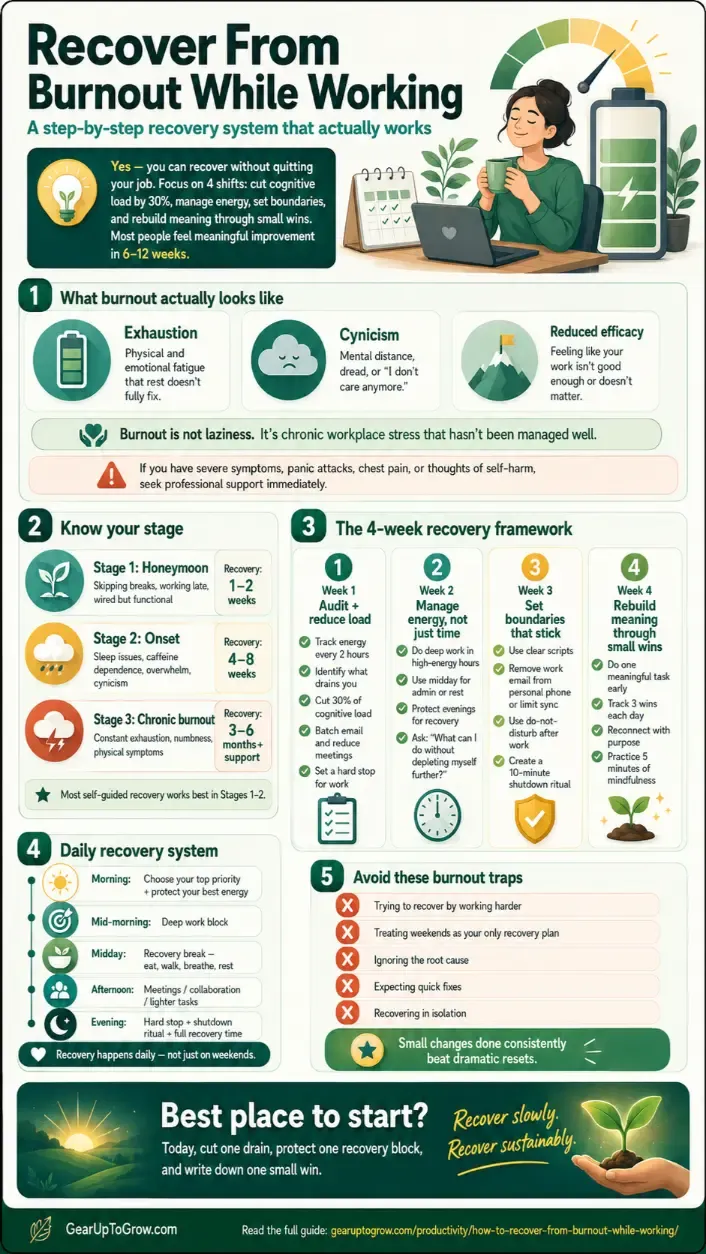
Figure: Burnout Recovery — visual summary of the key framework
How to Recover from Burnout While Working: A Step-by-Step Recovery System
The short answer: Yes, you can recover from burnout without quitting your job — but not by “pushing through.” Burnout recovery while working requires four shifts: (1) cut cognitive load by 30%, (2) manage energy, not just time, (3) set boundaries that protect recovery, and (4) rebuild meaning through small wins. Most people see meaningful improvement in 6–12 weeks with consistent practice.
Who This Is For
This guide is for working professionals who feel chronically exhausted, emotionally detached from work, and stuck in a cycle where rest never feels restorative. You might have read our burnout symptoms guide and recognized yourself. You can’t quit your job right now — but you can’t keep going like this either. This guide is your middle path.
Who Should Skip This
If you’re experiencing clinical depression, thoughts of self-harm, or severe physical symptoms (chest pain, panic attacks, suicidal ideation), this guide is not sufficient. Please contact a mental health professional or crisis line immediately. Burnout can co-occur with depression, and professional assessment is essential when symptoms are severe.
Our Methodology
We reviewed burnout research from the World Health Organization (ICD-11 classification), the American Psychological Association, and peer-reviewed studies from the National Institutes of Health. We focused on studies of burnout recovery among employed adults — not sabbatical-based or leave-based recovery. Every recommendation maps to an evidence-based recovery mechanism.
What Burnout Actually Is (And Isn’t)
The World Health Organization classifies burnout in the ICD-11 as an occupational phenomenon resulting from chronic workplace stress that has not been successfully managed. It has three dimensions:
- Feelings of energy depletion or exhaustion — physical and emotional fatigue that rest doesn’t fix
- Increased mental distance from one’s job, or negativism/cynicism related to one’s job — the “I don’t care anymore” feeling
- Reduced professional efficacy — a sense that nothing you do matters or is good enough
Burnout is not laziness. It’s not a personality flaw. It’s not “just stress.” It’s a measurable physiological and psychological state that develops when your stress response stays activated for too long without adequate recovery. Research from the Journal of Occupational Health Psychology shows that burnout involves measurable changes in cortisol patterns, sleep architecture, and immune function.
The 3 Stages of Burnout: Where Are You?
Stage 1: The Honeymoon Phase
High engagement, high energy, but early warning signs appear: skipping breaks, working late occasionally, feeling “wired” but functional. You’re productive but starting to neglect recovery. This is the easiest stage to reverse — but most people miss the signs.
Stage 2: Onset
The signals get louder. Sunday dread becomes weekly. Sleep quality drops. You start using caffeine or sugar to function. Cynicism creeps in. Small tasks feel overwhelming. Your chronic stress response is now constantly activated. Recovery at this stage takes 4–8 weeks of consistent intervention.
Stage 3: Chronic Burnout
Exhaustion is constant. You feel emotionally numb or deeply cynical about work. Physical symptoms appear — headaches, gastrointestinal issues, frequent illness. Productivity drops despite longer hours. Recovery at this stage takes 3–6 months and may require professional support, reduced work hours, or a role change.
| Stage | Key Signs | Recovery Time | Primary Need |
|---|---|---|---|
| 1. Honeymoon | Skipping breaks, working late, wired but functional | 1–2 weeks | Awareness + boundaries |
| 2. Onset | Sleep issues, cynicism, caffeine dependence, overwhelm | 4–8 weeks | Energy management + load reduction |
| 3. Chronic | Constant exhaustion, numbness, physical symptoms | 3–6 months | Professional support + role change |
The 4-Week Burnout Recovery Framework
This framework is designed for people in Stages 1–2 who need to recover while continuing to work. If you’re in Stage 3, start here but also seek professional support.
Week 1: Audit and Reduce Cognitive Load
The first week isn’t about adding new habits — it’s about removing demands. Your brain is overloaded, and adding “recovery activities” to a full schedule creates more stress.
Day 1–2: Energy Audit
For two days, track your energy every 2 hours on a 1–5 scale. Note what drained you and what energized you. You’ll likely find that 20% of your tasks consume 80% of your energy. This is your target list for reduction.
| Time | Energy (1-5) | Activity | Effect (+/-) |
|---|---|---|---|
| 8 AM | 4 | Checking email | — draining |
| 10 AM | 3 | Meeting-heavy block | — draining |
| 12 PM | 2 | Lunch (skipped again) | — depleted |
| 2 PM | 3 | Deep work alone | + energizing |
| 4 PM | 1 | Another meeting | — draining |
Day 3–7: Cut 30% of Cognitive Load
- Batch communication: Check email 3 times daily (not continuously). Each notification costs attention-switching energy.
- Decline or delegate: Identify 3 recurring meetings you can skip, delegate, or make async. A 2022 study in MIT Sloan Management Review found that reducing meeting load by 30% improved both productivity and wellbeing.
- Eliminate decisions: Eat the same breakfast, wear similar clothes, pre-plan your week. Decision fatigue is real — each unnecessary choice drains energy your brain needs for recovery.
- Set a hard stop: Pick a time when work ends — and enforce it. This is non-negotiable. See our stress relief guide for boundary techniques.
Week 2: Manage Energy, Not Just Time
Time management tells you when to work. Energy management tells you what kind of work your brain can handle. Burnout recovery requires matching task type to energy level.
- Mornings (highest energy): Reserve for deep, meaningful work. This is when your brain is most capable of the focus that creates a sense of competence — the antidote to burnout’s “reduced efficacy” dimension.
- Mid-day (energy dip): Use for routine tasks, admin, or rest. A 20-minute nap or walk is more productive than forcing through low energy.
- Afternoons (moderate energy): Collaborative work, meetings, creative problem-solving with others.
- Evenings (recovery time): Protect aggressively. Your brain needs downtime to process and repair. See our guide on sleeping better for recovery sleep strategies.
The key shift: stop asking “How much can I get done today?” and start asking “What can I do without depleting myself further?”
Week 3: Set Boundaries That Actually Stick
Boundaries fail when they’re vague (“I’ll work less”) or when they rely on willpower (“I’ll say no more”). Effective boundaries are specific, pre-committed, and have structural support.
Boundary scripts that work:
- “I can take this on, but not until next week. I’ll have capacity Tuesday.” (Buys time without saying no)
- “I’ll need to drop something else if I take this. Which would you prefer I deprioritize?” (Forces realistic prioritization)
- “I’m unavailable after 6 PM. I’ll respond in the morning.” (Clear, non-negotiable)
- “I can do 80% of this by Friday. The remaining 20% will come Monday.” (Sets realistic expectations upfront)
Structural boundary supports:
- Remove work email from your personal phone (or set it to manual sync only)
- Schedule your hard stop as a recurring calendar event — treat it like a meeting
- Use “do not disturb” modes after work hours — silence all notifications
- Build a shutdown ritual: 10 minutes to close tabs, write tomorrow’s top 3 priorities, and mentally “leave” work
Week 4: Rebuild Meaning Through Small Wins
Burnout’s third dimension — reduced professional efficacy — can’t be fixed by rest alone. You need to rebuild a sense that your work matters. But aiming for big wins while exhausted leads to more failure. Instead, engineer small, guaranteed wins.
- Identify one task daily that you’re good at and that matters. Do it first. The sense of competence generates motivation.
- Track wins visibly. Write down 3 things you accomplished each day — even small ones. Burnout narrows your focus to failures; this counteracts that bias.
- Reconnect with purpose. Write one sentence about why your work matters to someone. Not a corporate mission statement — a real person who benefits from what you do.
- Practice mindfulness exercises — even 5 minutes daily. Research from the APA shows mindfulness reduces burnout’s emotional exhaustion dimension specifically.
Comparison: Burnout Recovery Strategies
| Strategy | What It Does | Best For | Time Required | Evidence |
|---|---|---|---|---|
| Cognitive load reduction | Frees mental bandwidth for recovery | Week 1 — immediate relief | Minimal (removing, not adding) | Strong — decision fatigue research |
| Energy management | Matches tasks to energy states | Week 2 — sustained recovery | 10 min daily tracking | Moderate — circadian rhythm studies |
| Boundary setting | Protects recovery time from work intrusion | Week 3 — preventing relapse | 5 min per boundary | Strong — work-recovery research |
| Mindfulness practice | Reduces emotional exhaustion and rumination | Week 4+ — ongoing | 5–20 min daily | Strong — multiple meta-analyses |
| Sleep optimization | Restores physiological recovery systems | All weeks — foundational | 8 hours nightly | Very strong — sleep and stress research |
| Exercise | Reduces cortisol, improves mood, aids sleep | Week 2+ — when energy allows | 20–30 min, 3x weekly | Strong — exercise and burnout studies |
| Professional therapy | Addresses underlying depression, anxiety, trauma | Stage 3 or persistent symptoms | Weekly sessions | Very strong — clinical evidence |
Common Mistakes in Burnout Recovery
1. Trying to Recover by Working Harder
The most common mistake. Burnout feels like underperformance, so the instinct is to push harder. This deepens the exhaustion. Recovery requires less output, not more — at least temporarily. Read our mental wellness guide for more on this paradox.
2. Treating Weekends as Recovery
If your weekdays are 100% depleted, two days can’t refill the tank. You need daily recovery windows — not just weekend marathons of rest. A 30-minute daily recovery break is more effective than a 14-hour weekend crash.
3. Not Addressing the Root Cause
Recovery strategies manage symptoms. But if your workload is genuinely unsustainable, or your workplace is toxic, symptom management alone will fail. Be honest about whether the problem is you (needing better boundaries) or the environment (needing a change). See our Mental Wellness Hub for deeper resources.
4. Expecting Quick Fixes
Burnout develops over months; recovery takes weeks to months. People who expect to feel better after a weekend of rest get discouraged and give up. Set realistic expectations: Week 1 feels slightly better, Week 2 noticeably better, Week 4 significantly better.
5. Recovering Alone
Burnout isolates. The cynicism and exhaustion make you withdraw from others. But social connection is one of the most powerful recovery mechanisms. Tell a trusted person what you’re going through. If symptoms persist beyond 8 weeks of self-guided recovery, seek professional support.
Burnout Recovery FAQ
Can you recover from burnout while working?
Yes. Research shows that burnout recovery while employed is possible when you systematically reduce cognitive load, manage energy, set boundaries, and rebuild meaning. The key is consistent, small changes rather than dramatic overhauls. Most people in early-to-moderate burnout see significant improvement in 6–12 weeks.
How long does burnout recovery take?
It depends on the stage. Stage 1 (honeymoon) burnout can reverse in 1–2 weeks with boundary-setting. Stage 2 (onset) typically takes 4–8 weeks of consistent recovery practices. Stage 3 (chronic) burnout may take 3–6 months and often requires professional support or role changes.
Do I need to quit my job to recover from burnout?
Not always. Many people recover while employed by reducing load, setting boundaries, and managing energy. However, if your burnout stems from a toxic workplace, unsustainable workload, or values mismatch that you cannot change, a job change may be necessary. Try the 4-week framework first — if you see no improvement after 8 weeks, consider whether the environment itself is the problem.
What’s the difference between burnout and depression?
Burnout is specifically work-related and characterized by exhaustion, cynicism, and reduced efficacy. Depression is broader, affecting all areas of life, and includes symptoms like loss of interest in previously enjoyed activities, changes in appetite, and feelings of worthlessness. They can co-occur. If symptoms extend beyond work or include thoughts of self-harm, seek professional assessment.
Should I see a therapist for burnout?
If your symptoms are moderate to severe, persist beyond 4–6 weeks of self-guided recovery, or include signs of depression or anxiety, yes. A therapist can help you identify root causes, develop coping strategies, and determine whether your situation requires environmental changes that self-help can’t address.
Sources and References
- World Health Organization. (2019). Burn-out an “occupational phenomenon”: International Classification of Diseases. WHO ICD-11 classification. — Official burnout definition and classification.
- Maslach, C., & Leiter, M. P. (2016). Understanding the burnout experience. JAMA, 316(7), 797–798. — Foundational burnout research and the Maslach Burnout Inventory.
- Salvagioni, D. A., et al. (2017). Physical, psychological and occupational consequences of job burnout: A systematic review. International Journal of Environmental Research and Public Health, 14(9), 1025. — NIH/PMC review of burnout’s health effects.
- American Psychological Association. (2023). Work in America Survey. — APA data on workplace burnout prevalence and recovery factors.
- Demerouti, E., et al. (2001). The job demands-resources model of burnout. Journal of Applied Psychology, 86(3), 499–512. — Evidence-based model for understanding burnout causes and recovery.
- Mayo Clinic. (2023). Job burnout: How to spot it and take action. — Clinical perspective on burnout symptoms and recovery.
Related Reading
- Burnout Symptoms: How to Recognize the Signs — Start here if you’re not sure if you have burnout
- Chronic Stress: Causes, Effects, and Management — Understanding the stress response that drives burnout
- Stress Relief Techniques That Actually Work — Practical stress reduction strategies
- Mental Wellness Guide — Comprehensive guide to mental wellbeing
- Mindfulness Exercises for Daily Practice — Evidence-based mindfulness practices
- How to Sleep Better — Sleep is foundational to burnout recovery
Disclaimer: This article is educational, not medical advice. If you are experiencing severe burnout, depression, or thoughts of self-harm, please contact a qualified mental health professional or crisis line immediately. In the US, call or text 988 for the Suicide & Crisis Lifeline.
Author: Alexios Papaioannou — Editor, Gear Up to Grow. Researches and writes evidence-informed guides on productivity, focus, and mental wellness. About the editor.
Last updated: July 2026. This article follows our editorial policy and review methodology.