
Quick answer: A personal development plan is a practical roadmap for improving your skills, habits, mindset, and results over time. The best plan is not a long wish list. It names one to three priorities, turns them into weekly actions, sets review checkpoints, and helps you adjust when life changes.
Editorial note: Reviewed and refreshed on 2026-06-02 for clarity, answer-engine extraction, safer claims, stronger examples, and better internal guidance. Claims that need outside verification are marked in the verification checklist below.
What Is a Personal Development Plan?
A personal development plan is a structured outline of what you want to improve, why it matters, what actions you will take, and how you will review progress. It can cover career growth, confidence, communication, health habits, learning goals, emotional resilience, productivity, or life direction.
The useful version is simple: choose a focus, define the outcome, break it into weekly actions, track the behavior, and review what is working. If you are new to this topic, start with our broader guide to self-improvement.
Who This Is For — and Who It Is Not For
- This is for you if: you want a realistic growth plan, feel scattered, have several goals competing for attention, or want a repeatable way to turn goals into action.
- This is also for you if: you are changing careers, rebuilding habits, improving confidence, learning a skill, or trying to follow through more consistently.
- This is not for you if: you want a motivational fantasy document you never review, a 12-month plan with no weekly actions, or a plan based on someone else’s priorities.
Personal Development Plan Decision Table
Use this table to decide what kind of plan you need before you start writing.
| Situation | Best plan type | Primary focus | Review rhythm |
|---|---|---|---|
| You feel overwhelmed | 30-day reset plan | One habit, one skill, one boundary | Weekly |
| You want career growth | 90-day skill plan | One high-value skill plus proof of work | Weekly + monthly |
| You lack consistency | Habit-first plan | Small daily actions and environment design | Twice weekly |
| You have many goals | Priority filter plan | Choose one to three goals and cut the rest | Weekly |
| You are stuck or unmotivated | Momentum plan | Remove friction and create small wins | Every 3–7 days |
Why Most Development Plans Fail
Most development plans fail because they are written like wish lists instead of operating systems. “Become healthier,” “be more confident,” or “learn more” may sound inspiring, but they do not tell you what to do next Tuesday at 7 p.m.
A stronger plan answers four questions:
- What am I trying to improve?
- Why does it matter now?
- What action will I repeat each week?
- How will I know whether the plan is working?
If your plan does not change your calendar, environment, or behavior, it is probably not a plan yet. It is only an intention.
The 5-Layer Development Plan Framework
The simplest personal development plan has five layers: identity, goals, skills, habits, and review. Each layer keeps the plan grounded so you do not depend on motivation alone.
Layer 1: Identity — Decide Who You Are Becoming
Before choosing tactics, define the type of person you are trying to become. This keeps the plan connected to values instead of random productivity hacks.
- I am becoming someone who…
- I want this because…
- I will know I am making progress when…
Example: “I am becoming someone who communicates clearly under pressure. I want this because I avoid difficult conversations. I will know I am making progress when I can prepare, speak directly, and leave fewer things unsaid.”
Layer 2: Goals — Choose One to Three Outcomes
A good plan does not need ten goals. It needs a few outcomes that matter enough to guide decisions. If you need a deeper goal-setting process, use our guide on success habits to connect goals with repeatable behavior.
- Outcome: what you want to improve.
- Reason: why it matters.
- Metric: how you will observe progress.
- Deadline: when you will review, not when you must become perfect.
Example: “Improve public speaking confidence by practicing one short presentation per week for eight weeks and asking for feedback after each session.”
Layer 3: Skills — Pick the Highest-Leverage Skill
Not every skill deserves equal attention. Choose the skill that creates the most useful downstream improvement. For career growth, that may be communication, writing, leadership, sales, data analysis, coding, project management, or decision-making.
- Which skill would make my current work easier?
- Which skill would create better opportunities?
- Which skill am I avoiding because it feels uncomfortable?
- Which skill can I practice in small weekly reps?
Layer 4: Habits — Turn the Plan Into Repeated Actions
Goals describe direction. Habits create movement. A development plan becomes useful when every goal has a small behavior attached to it.
- Trigger: after an existing routine.
- Action: a version so small you can do it on a busy day.
- Proof: a simple checkmark, note, or calendar record.
- Review: one sentence about what helped or blocked you.
Example: “After morning coffee, I will write three bullet points about the skill I am practicing today.” If consistency is your main issue, read Self-Discipline: A Practical System for Following Through.
Layer 5: Review — Adjust the Plan Before It Breaks
A plan is not supposed to be perfect. It is supposed to be reviewed. Use a weekly review to decide what to keep, stop, or simplify.
- Keep: what helped you make progress?
- Stop: what created friction or wasted energy?
- Simplify: what can be made smaller or easier?
- Next: what is the one action for next week?
For a reflection habit, see the guide to journaling benefits.
How to Create a Personal Development Plan Step by Step
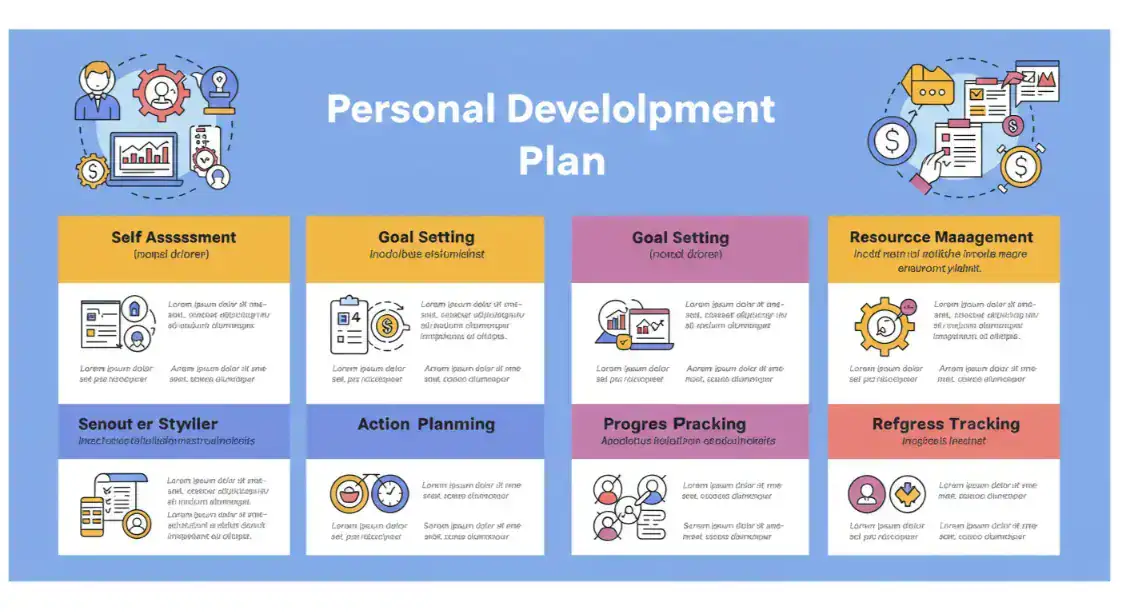
Follow these steps in order. Do not skip the review step; that is where most plans become realistic.
Step 1: Audit Your Current Situation
Write down what is working, what feels stuck, and what keeps repeating. Keep it practical: time, energy, skills, habits, relationships, work, health, confidence, or decision-making.
Step 2: Choose One Main Development Area
Pick the area that would make the biggest difference right now. If everything feels urgent, choose the area that reduces the most friction in daily life.
Step 3: Define the Outcome
Turn the focus area into a clear outcome. Avoid vague language. “Improve confidence” becomes “speak up at least once in every weekly team meeting for the next six weeks.”
Step 4: Break It Into Weekly Actions
Choose actions that fit your real calendar. If you need help protecting time, use a time blocking framework to reserve space for practice.
Step 5: Choose Your Proof of Progress
Proof can be simple: a completed practice session, a journal note, a finished lesson, a conversation attempted, a workout completed, or a project shipped.
Step 6: Add Accountability
Accountability does not have to be public. It can be a weekly note to yourself, a coach, a peer, a checklist, or a recurring calendar review.
Step 7: Review and Adjust
At the end of each week, ask: What worked? What got in the way? What should I simplify next week? This prevents one bad week from destroying the whole plan.
Examples by Situation
| Situation | Development goal | Weekly action | Review question |
|---|---|---|---|
| Career growth | Improve communication | Prepare one concise update before each meeting | Was my message clear and useful? |
| Low motivation | Build momentum | Complete one 10-minute action each weekday | What made starting easier? |
| Skill building | Learn a new tool or topic | Practice 3 focused sessions per week | What can I now do that I could not do before? |
| Confidence | Speak up more often | Contribute once in a meeting or group discussion | What did I avoid, and why? |
| Health habits | Improve daily energy | Choose one sleep, movement, or nutrition habit | Did this improve my day or add stress? |
12 AI Prompts to Build Your Personal Development Plan
Use these prompts as thinking aids. Do not let AI choose your values for you; use it to clarify, organize, and pressure-test your plan.
- “Help me identify the top three areas of my life where a personal development plan would create the most useful improvement. Ask me clarifying questions first.”
- “Turn this vague goal into a clear personal development outcome with a metric, weekly action, and review date: [insert goal].”
- “Create a 30-day personal development plan for improving [skill/habit], using small daily actions and a weekly review.”
- “Help me choose between these goals by ranking them by urgency, long-term value, and realistic effort: [list goals].”
- “Convert this outcome into a weekly action plan that fits into three 30-minute sessions per week: [insert outcome].”
- “Give me five tiny habit versions of this action so I can continue even on low-energy days: [insert habit].”
- “Act as a coach and ask me 10 questions to find the real obstacle behind my lack of follow-through.”
- “Create a weekly review template for my personal development plan with keep, stop, simplify, and next-action sections.”
- “Help me design an accountability system that does not rely on public posting or shame.”
- “Find possible failure points in this plan and suggest simple fixes: [paste plan].”
- “Turn my personal development plan into a one-page checklist I can review every Friday.”
- “Create three versions of this plan: minimum effort, realistic, and ambitious: [paste plan].”
Common Mistakes and Troubleshooting
Mistake 1: Choosing Too Many Goals
If your plan has more than three major goals, it may become a stress list. Cut it down to the few goals that matter most right now.
Mistake 2: Confusing Planning With Progress
A beautiful plan is not progress. Progress is the repeated action you can point to. If you keep redesigning the plan, choose one small action and do it today.
Mistake 3: Relying on Motivation
Motivation rises and falls. Build the plan around reminders, calendar blocks, small starts, and easier environments. If this is your main blocker, read how to boost motivation.
Mistake 4: Making Actions Too Big
If you keep missing the action, shrink it. A 10-minute practice session that happens is better than a 90-minute session you keep avoiding.
Mistake 5: Quitting After One Bad Week
A missed week is data, not failure. Use the review to find the friction. If the plan requires a perfect week, it is not resilient enough. For deeper follow-through problems, see how to stop making excuses.
Optional Tools for Building Your Plan
Affiliate disclosure: Some links below may be affiliate links. If you buy through them, Gear Up to Grow may earn a commission at no extra cost to you. Do not buy tools you will not use; a notebook and calendar are enough to start.
Personal development planner
Useful if you prefer a physical workbook for goals, habits, and weekly reviews.
Goal-setting journal
Useful if reflection helps you notice patterns, obstacles, and progress over time.
Habit tracker notebook
Useful if your main challenge is consistency rather than strategy.
Video: Personal Development Planning Walkthrough
Frequently Asked Questions
What should a personal development plan include?
A personal development plan should include your main focus area, one to three goals, weekly actions, a timeline, proof of progress, and a review process. It should be short enough to use and specific enough to guide behavior.
How many goals should I include?
Most people should start with one to three goals. Too many goals make the plan harder to follow. If you are unsure, choose one main goal for 30 days and add more only after you build consistency.
How often should I review my personal development plan?
Review your plan weekly if you are building a new habit or skill. A monthly review works for bigger direction changes. The key is to adjust the plan before small problems become reasons to quit.
What is the difference between a personal development plan and a goal list?
A goal list names what you want. A personal development plan explains why it matters, what actions you will take, when you will do them, and how you will review progress.
Can I create a personal development plan without a coach?
Yes. A coach can help with feedback and accountability, but you can start with a simple self-guided plan: choose one priority, define the outcome, schedule weekly actions, and review honestly.
What if I stop following the plan?
Do not restart from zero. Review what made the plan hard to follow, shrink the next action, and continue with a simpler version. A plan that can recover after disruption is stronger than a perfect plan that breaks easily.
What is the best personal development plan template?
The best template is one you will review. It should have five parts: focus area, goal, weekly action, progress proof, and review notes. If a template is too complicated to use every week, simplify it.
Sources and Editorial Note
This article is written as practical educational guidance, not medical, psychological, legal, or financial advice. It was reviewed for clarity, unsupported claims, internal linking, answer-engine extraction, and usefulness on 2026-06-02.
Recommended external sources to verify before adding precise statistics: university goal-setting resources, APA resources on behavior change, peer-reviewed habit-formation research, and reputable coaching or psychology references. Do not keep precise statistics in the article unless the source is confirmed.
Next Step
Start with one focus area and one weekly action. Write the plan in less than 20 minutes, schedule the first action, and review it at the end of the week. The goal is not to build a perfect document; it is to build a plan you actually use.